


Functional Committees
In order to strengthen the supervisory responsibility of the board of directors and enhance the operational mechanism of the board management, Neousys Technology has established functional committees such as the Audit Committee, the Compensation Committee and the Sustainable Development Committee.
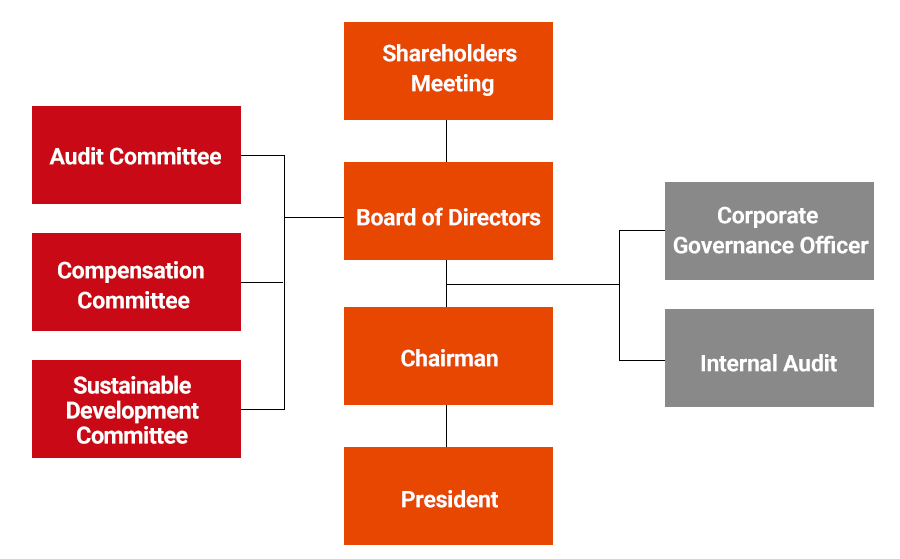
| Title | Name | Audit Committee | Compensation Committee |
| Independent Director | Ryan Chen | ✓ | ✓ |
| Grant Kuo | ✓ | ✓(Convener) | |
| Sean Fan | ✓ | ✓ | |
| Ray Lai | ✓(Convener) | ✓ |
Audit Committee
In order to strengthen the supervisory responsibility of the board of directors and enhance the management mechanism of the board, Neousys Technology established the Audit Committee in December 2022. The Neousys Technology Audit Committee is composed of all independent directors, and at least one of them should possess accounting or financial expertise.
Operation of the Audit Committee
The main purpose of the following matters is to supervise:
1. The appropriate expression of the company's financial statements.
2. Selection, dismissal, independence and performance of the certified public accountant.
3. Effective implementation of the company's internal control.
4. Compliance with relevant laws and regulations.
5. Control of existing or potential risks of the company.
Powers of the Audit Committee
1. To establish or amend internal control systems in accordance with Article 14-1 of the Securities and Exchange Act.
2. Assessment of the effectiveness of the internal control system.
3. Establishing or amending procedures for significant financial transactions, such as acquisition or disposition of assets, derivative trading, lending of funds to others, endorsement or guarantee for others, in accordance with Article 36-1 of the Securities and Exchange Act.
4. Matters involving the self-interest of directors.
5. Significant asset or derivative transactions.
6. Significant lending, endorsement or guarantee of funds.
7. Equity securities with equity nature raised, issued, or privately placed.
8. Appointment, dismissal or compensation of certified public accountants.
9. Appointment or dismissal of financial, accounting or internal audit heads.
10. Annual financial reports signed or stamped by the Chairman, managers and accounting heads, and second-quarter financial reports that must be audited and certified by a certified public accountant.
11. Other significant matters prescribed by the company or competent authorities.
The resolutions on the preceding matters shall be passed with the approval of more than half of the members of the Committee and submitted to the Board of Directors for resolution. With the exception of item 10, if the aforementioned matters are not approved by more than half of the members of the Committee, they may be carried out with the approval of more than two-thirds of all directors.
The term "all members" referred to above shall be calculated based on the actual number of members in office. The convener of the Committee shall represent the Committee externally.
- Communication between independent directors, the head of internal audit, and the accountant: 2025(attached file) | 2024(attached file) | 2023(attached file)
- Annual Audit Committee work focus and important resolutions: 2025((attached file) | 2024(attached file) | 2023(attached file)
Compensation Committee
Composition of the Compensation Committee
- The committee shall consist of four members appointed by the board of directors, with at least half of the majority of members being independent directors.
- The professional qualifications and independence of the members of the committee shall comply with the provisions of Articles 5 and 6 of the "Regulations Governing the Establishment and Exercise of Powers of Compensation Committees of Public Companies or Companies Whose Securities are Listed on Securities Exchange or Traded Over-the-Counter" (hereinafter referred to as the "Compensation Committee Regulations").
- The administrative unit responsible for the affairs of the committee shall be responsible for assisting the committee in preparing the agenda, convening and conducting meetings, keeping minutes of meetings, and other related matters.
(1) In accordance with Article 7 of the Compensation Committee Regulations, the committee shall faithfully perform the following duties with the care of a good administrator and submit its recommendations to the board of directors for discussion:
- Regularly review relevant rules and procedures and propose revisions.
- Establish and regularly review policies, systems, standards, and structures for evaluating the performance and compensation of directors and senior management.
- Regularly evaluate and establish the compensation of directors and senior management.
(2) When performing the above duties, the compensation committee shall adhere to the following principles:
- Ensure that the company's compensation system is reasonable, complies with relevant laws and regulations, and is sufficient to attract outstanding talents.
- The performance evaluation and compensation of directors and senior management should be based on the usual industry standards and take into account the reasonableness of their personal performance, the company's business performance, and future risks.
- The compensation committee should not induce directors and senior management to engage in risky behavior to pursue compensation.
- The proportion of short-term performance-based dividends and variable compensation payment periods for directors and senior management should be determined based on industry characteristics and the nature of the company's business.
(3) The compensation referred to in the previous two items includes cash compensation, stock options, stock dividends, retirement benefits or severance payments, various allowances, and other measures with substantial rewards. Its scope should be consistent with the criteria for disclosure items in the annual report of a publicly traded company related to director and senior management compensation.
(4) If the matters related to the compensation of directors and senior management of a subsidiary of the company are subject to the approval of the parent company's board of directors based on the subsidiary's hierarchical responsibility, the compensation committee of the parent company shall first submit its recommendations to the board of directors for discussion.
Sustainable Development Committee