Key Takeaways
- As vehicle applications continue to demand higher GPU performance, stable and clean electrical power delivery becomes a fundamental system requirement rather than an optional design consideration.
- In GPU-based vehicle systems, electrical power instability presents a latent risk—even when failures have not yet surfaced in early deployments.
- RPM-450 mitigates this risk through front-end electrical power conditioning, protecting high-power GPU systems from voltage fluctuation before failures occur in field deployments.
As GPU computing becomes essential for vehicle-based AI applications, system designers tend to focus on processing capability, GPU selection, and thermal management. Yet in real-world deployments, system instability is often traced back to a far less visible factor: unstable power input. In vehicle environments, electrical power sources are inherently unstable and rarely clean by default. As GPU performance scales upward, electrical power stability becomes mission-critical.
The Growing Role of GPUs in Vehicle Applications
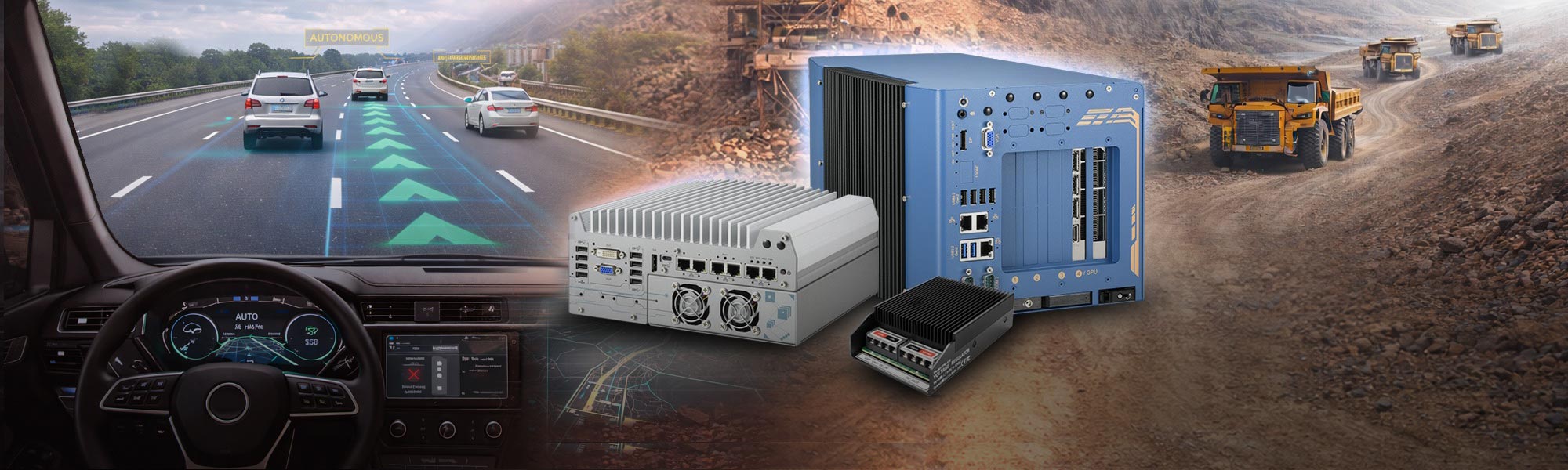
High-performance GPU computers are often deployed in vehicles to support AI-driven applications such as ADAS and autonomous perception, smart transportation systems, and off-highway vehicles used in smart agriculture, mining, and construction. These applications rely on real-time vision processing, sensor fusion, and on-site analytics. To meet these demands, system integrators adopt high-power GPU platforms such as Nuvo-9160GC and Nuvo-10108GC for reliable vehicle-based AI computing.
High Compute Power Exposes a Critical Weakness: Vehicle's Electrical Power Delivery
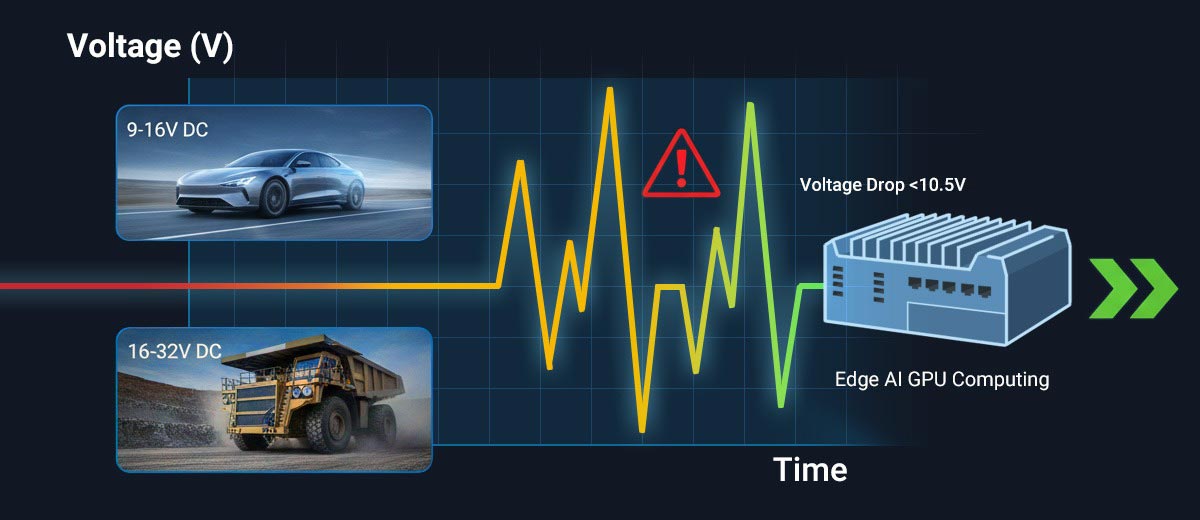
As GPU capability increases, overall electrical power demand rises accordingly. Under heavy workloads such as AI inference, video analytics, and sensor fusion, GPU systems operate across a wide and highly dynamic load range, resulting in substantial current demand at the system level. In vehicle environments, electrical power instability originates from the vehicle electrical system itself. During vehicle operation, factors such as engine cranking, load switching, vibration, and different operating phases can cause the supply voltage to fluctuate or momentarily drop—in some cases falling to 10 V or even below. In addition to operational conditions, voltage drop caused by power distribution wiring—such as cable resistance, connector losses, and routing length—is another frequently overlooked contributor to supply voltage degradation, particularly under high current load.
When such voltage sag occurs, high-power GPU systems draw increased current to maintain operation, significantly amplifying the impact of transient power disturbances.
As a result, even millisecond-level voltage drops or transient disturbances can trigger GPU card disconnections, PCIe dropouts, system freezes, unexpected shutdowns, data corruption, or data loss—leading to costly downtime and potential hardware damage. GPU systems do not generate electrical power instability; however, under heavy and dynamic loads, they significantly reduce the system's tolerance to unstable input electrical power. This challenge does not originate from GPU architecture itself, but from inadequate electrical power conditioning at the system input level.
Why Clean and Stable Electrical Power Matters
High-performance GPU systems are significantly less tolerant of power instability than traditional embedded computers. As electrical power demand increases, the margin for voltage fluctuation rapidly diminishes. Providing clean and regulated voltage before power reaches the GPU computer is essential to prevent voltage drop–induced failures, protect GPU cards and PCIe components, and maintain system uptime in harsh vehicle environments. Without proper front-end electrical power conditioning, even the most advanced GPU system cannot deliver reliable performance in real-world vehicle deployments.
RPM-450 : Front-End Electrical Power Conditioning for GPU Computer in Vehicle
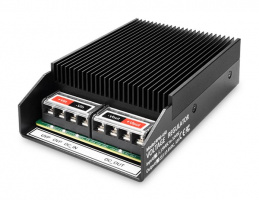
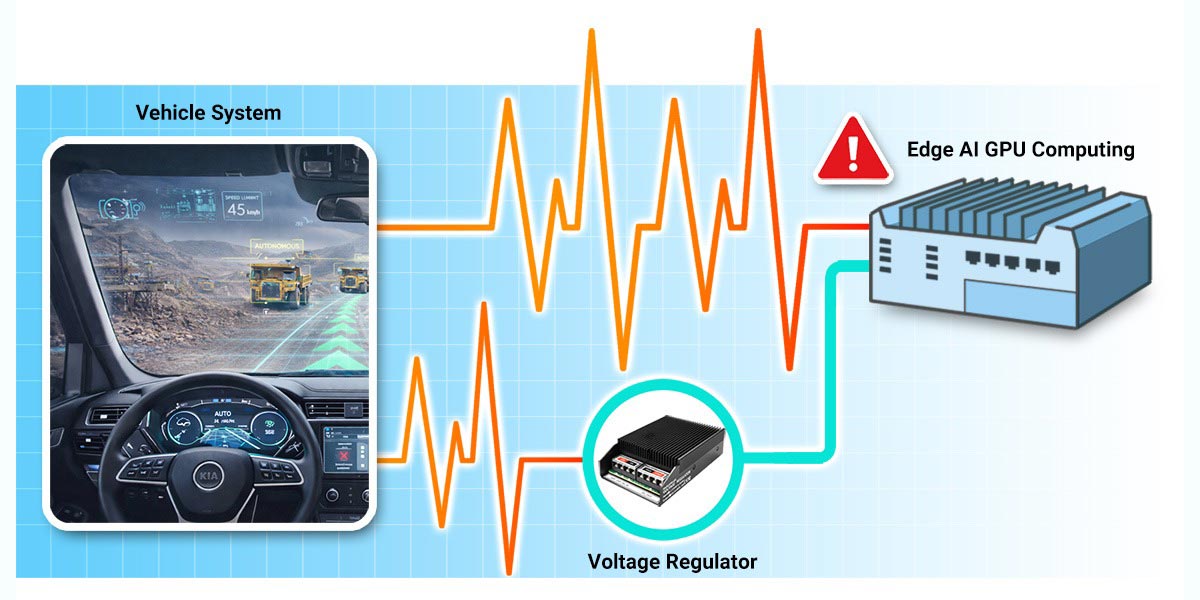
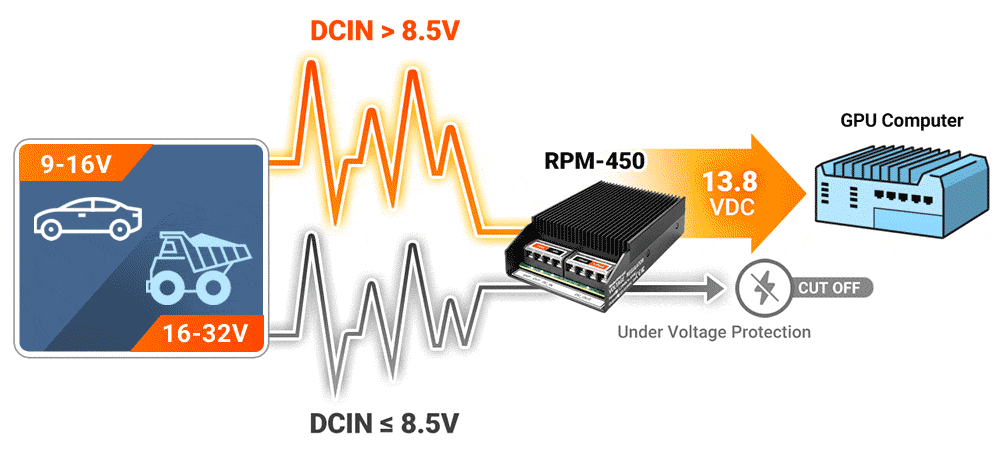
RPM-450 is a rugged, high-power DC power module designed specifically to solve this challenge. RPM-450 implements a clearly defined Undervoltage Protection (UVP) mechanism to prevent unstable vehicle power from propagating to back-end high-power systems and devices. When the input voltage drops below 8.5 V, RPM-450 performs a precise and controlled shutdown, fully disconnecting the output rather than bypassing degraded or collapsing voltage downstream. This ensures that connected systems are cleanly powered off instead of operating under undervoltage conditions that could lead to unpredictable system behavior, interface instability, data corruption, or long-term hardware stress. Once the input voltage recovers to 8.9 V or above, RPM-450 automatically restores output power in a controlled manner, allowing the system to resume normal operation without manual intervention. By enforcing defined undervoltage thresholds at the system power entry point, RPM-450 converts inherently unstable vehicle power into a predictable and well-managed input source for high-power computing platforms and peripheral devices.
RPM-450 provides:
- Wide 9–32VDC input, ideal for vehicle electrical power sources
- 450W Full load power support even at 9V input
- Stable and clean 13.8V output to protect high-performance GPU systems and high-power devices
- Millisecond-level MCU monitor and smartly manage DC supply to backward devices with UVP/OVP/SCP/OCP protection
- Reliable operation in harsh temperatures from -25°C to 70°C
- Compatible with third-party IPCs
Unlike conventional power supplies, RPM-450 enforces strict voltage boundaries at the system power entry point, ensuring that only clean and regulated voltage is delivered downstream, while undervoltage and overvoltage conditions are deliberately blocked rather than bypassed.
Preventing GPU System Failure with Clean, Stable Electrical Power
By stabilizing voltage before it reaches the GPU computer, RPM-450 prevents common failure scenarios in vehicle-based high-power systems, including GPU card dropouts under heavy load, unexpected shutdowns during ignition or power dips, data loss in recording and analytics workloads, and long-term hardware degradation. As an ideal front-end power solution for Neousys GPU platforms such as Nuvo-9160GC and Nuvo-10108GC, RPM-450 completes a vehicle-ready GPU computing architecture—from clean, regulated electrical power input to dependable AI acceleration output.
Frequently Asked Questions (FAQ)
- Why is front-end power conditioning required for in-vehicle GPU systems?
Vehicle power is unstable by nature. High-power GPUs have low tolerance for voltage fluctuation, and even brief voltage drops can cause system crashes, GPU dropouts, or data loss. Front-end power conditioning prevents unstable voltage from reaching the GPU system. - Why do voltage dips become critical under GPU workloads?
Under heavy AI workloads, GPUs draw high and dynamic current. When voltage drops, current demand increases, amplifying transient disturbances and triggering system instability or shutdowns. - How does RPM-450 solve this problem?
RPM-450 enforces defined undervoltage protection at the power entry point. It disconnects output when input voltage drops below 8.5 V and automatically restores power at 8.9V, ensuring only clean and stable power reaches the GPU system. - What makes RPM-450 different from conventional power supplies?
Unlike power supplies that pass unstable voltage downstream, RPM-450 blocks undervoltage conditions by design and delivers regulated 13.8 V output, protecting high-performance GPU platforms in vehicle environments.